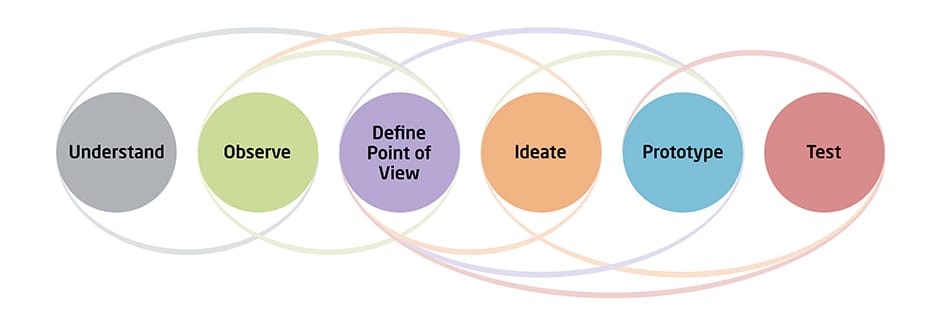
By telling about a MRI specialized for kids, she explained the importance of well-designed products and the experience of going through a coordinated iterative design process. The problem with the MRI for children was that the children were too afraid of the big machine and could not remain calm in the tube. So the aim was to make the MRI suitable for children. A design thinking process was used to achieve this: first understand the problem, then observe it, determine the point of view, work out ideas, develop a prototype and finally test it. But the big difference in this design thinking process is its structure: not linear, but iterative. It means going from the first step to the next, but also means going back one or two test phases again and repeating the steps to get a good result.